Saint-Louis is best visited slowly, which is exactly why two days are enough: an island to explore on foot at the right hour, a fishing district to see when the pirogues come back, an excursion to the birds or the Langue de Barbarie. Here is how to spread it all out without rushing.
Why two days are enough to visit Saint-Louis
Founded by the French in 1659 on an island at the mouth of the Senegal River, Saint-Louis was the capital of Senegal from 1872 to 1957, according to UNESCO, which listed the island for its regular urban plan, its quays and its colonial architecture. The city comes in three parts: the island, the historic heart; Sor, on the mainland bank, with the bus station and the markets; and the Langue de Barbarie, the strip of sand where the Guet N'Dar district is packed in.
Two full days on site means arriving the evening before, or leaving Dakar very early: our article on the Dakar to Saint-Louis road details the routes and the stops. On the way, a detour via Lake Retba (the Pink Lake) is best planned for the day before you leave.
Day one: Saint-Louis island, on foot and at the right hour
- Before 9 a.m., a walk around the islandSet off early: the low light brings out the ochre facades and the wooden or wrought-iron balconies, the heat is still bearable and the lanes are almost empty. The landmarks are Place Baya Ndar, the former Place Faidherbe, and the Governor's Palace. Allow two to three hours without hurrying, and don't expect an intact setting: several buildings suffer from a lack of maintenance, a few have been carefully restored.
- Late morning, the MuPhoThe photography museum occupies a restored colonial house and brings together contemporary African photography and archives from historic studios. Allow three quarters of an hour to an hour, and check opening hours and prices with the museum before going: they change.
- Lunch on the Sor side or in Guet N'DarThe terraces in the centre of the island are often pricier and less authentic. Saint-Louis claims to have invented thieboudienne, attributed to a cook named Penda Mbaye in the 19th century: this is the place to taste it. Order around noon, as the pots empty quickly.
- In the afternoon, a horse-drawn carriageWhen the heat weighs on you, the carriage tour of about an hour through the historic centre costs, according to 2026 surveys, between 5,000 and 10,000 FCFA for the whole carriage: a rough order of magnitude, to be negotiated. The Tourist Office, on the ground floor of the Governor's Palace, offers its own guides. For a guided visit from start to finish, the page car rental with a local guide in Saint-Louis describes the option.
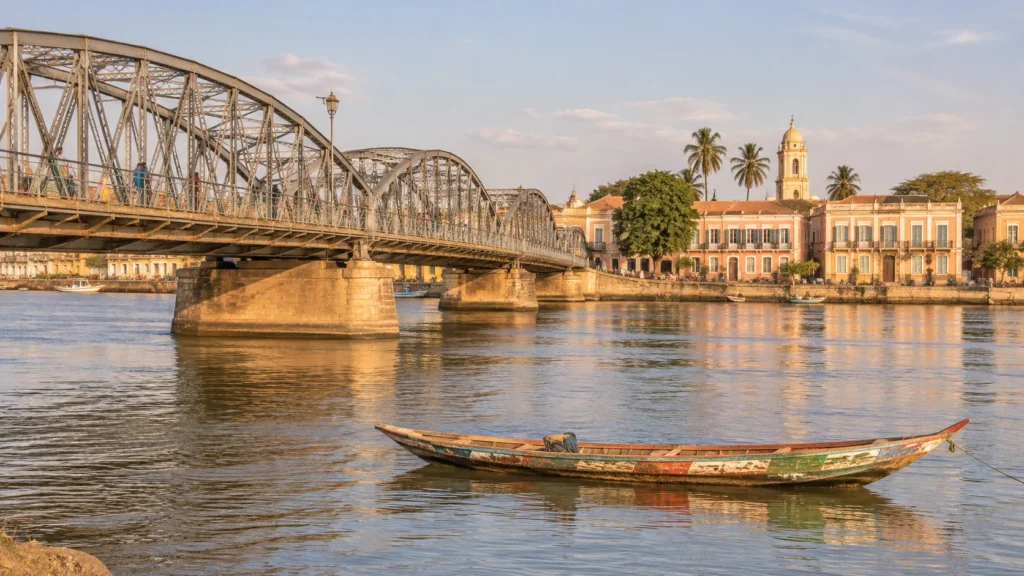
- At sunset, the Faidherbe Bridge on footBuilt in 1897 and 507 m long, it links the island to Sor. Contrary to legend, it was not designed by Gustave Eiffel. Cross it at the end of the day: the light falls on the river, pirogues pass below, the facades along the quays glow.
Day two: Guet N'Dar and an excursion of your choice
Keep the late afternoon for Guet N'Dar, which lies on the other side of the Moustapha Malick Gaye Bridge, on the Langue de Barbarie. It is one of the most densely populated fishing districts in West Africa: hundreds of painted pirogues lined up on the sand, fish drying in the sun, the catch sold directly on the beach. The ideal time is when the boats come back, in the late afternoon.
- ▸Always ask permission before photographing someone: it is a living neighbourhood, not an attraction.
- ▸Go on foot: the sandy lanes are too narrow for a carriage.
- ▸Visit in daylight, keep your valuables discreet, and don't swim on unsupervised beaches: the coastal currents are strong.
The morning of the second day is free for an excursion. The three options below cannot be combined.
Langue de Barbarie
The simplest half-day. The park entrance is about 22 km and 34 minutes by car from the city, then the visit continues by motorised pirogue through the lagoons. Local agencies offer excursions of about 4 hours for around 25,000 FCFA per person, transport, boat and entrance included: the Langue de Barbarie guide details how it unfolds.
Djoudj Park
A full day: about 53 km and 1 h 25 by road on the N2, an entrance fee of around 5,000 FCFA plus the pirogue. Migratory birds are present from November to April; outside the season, check before setting off. The Djoudj guide and our birdwatching calendar help you choose the date.
The river by pirogue
The relaxed option: a 1 h to 1 h 30 tour around the island, about 10,000 FCFA for the boat, to be shared among the passengers. Go through your accommodation to find a reliable boatman rather than accepting an offer on the quays, where the price often ends in a dispute.
Jazz, Fanals, seasons: when to visit Saint-Louis?
| Period | What happens | What to plan |
|---|---|---|
| November to April | Dry season, migratory birds at Djoudj and on the Langue de Barbarie | The best window for a first visit. |
| Late December | The Fanals, a lantern parade unique to Saint-Louis, between Christmas and New Year | Festive atmosphere, accommodation in higher demand. |
| May | Jazz festival: the 34th edition took place from 13 to 17 May 2026, the dates of the next one are still to be confirmed | Book at least three months ahead: the island fills up fast. |
| July to September | Rainy season, heavy air | The least comfortable for walking and for excursions. |
The festival, created in 1993, sets up its main stage on Place Faidherbe and spills into the inner courtyards and onto the riverbanks. If the island is full, Sor, on the mainland, remains a quieter and more affordable fallback.
Getting around Saint-Louis: on site and from Dakar
On the island, a car is of no use: everything is done on foot, and it is the accommodation that matters. If yours has no parking, ask before you arrive, then leave the vehicle. A car becomes useful for Djoudj and the Langue de Barbarie, or to continue south. From the city, car rental in Saint-Louis covers these outings. And if you came from Dakar and don't want to drive back the other way, one-way rental lets you return the car on site.
Frequently asked questions
Yes, for the island, Guet N'Dar and one excursion: one day for the city, one day for Guet N'Dar and the Langue de Barbarie or Djoudj. Beyond that, you mostly gain in slowness, which is no flaw here.
From November to April, in the dry season, when the migratory birds are at Djoudj. May suits the jazz festival, provided you book early.
Yes, on foot and in daylight, asking permission before photographing residents. A local guide helps you understand the district, but is not mandatory.
Not for the island, which is covered on foot. A car is useful for Djoudj Park (about 53 km, 1 h 25) and the Langue de Barbarie (about 22 km, 34 minutes to the park entrance).
About 4 h 43 for 257 km by the shortest route recorded on Google Maps. Add the stops and the exit from Dakar: allow half a day.
The essentials for two days in Saint-Louis
The island is best covered early in the morning and at sunset, Guet N'Dar is visited when the pirogues return, and Djoudj or the Langue de Barbarie fill the following morning. The rest is a matter of calendar: dry season, jazz in May, Fanals in December.
Explore Saint-Louis and the Grand Nord at your own pace
A car, with or without a driver, for Djoudj, the Langue de Barbarie and the return by the route of your choice.
Book my car in Saint-Louis →