The Lompoul desert no longer quite looks the way the photos show it: the neighbouring zircon mine has closed or moved camps, and the last stretch of track can only be driven in a 4x4. Here is what to check before booking, how to get there from Dakar, how much a night costs in 2026 and how to organise the evening.
Lompoul in 2026: what has changed before you book
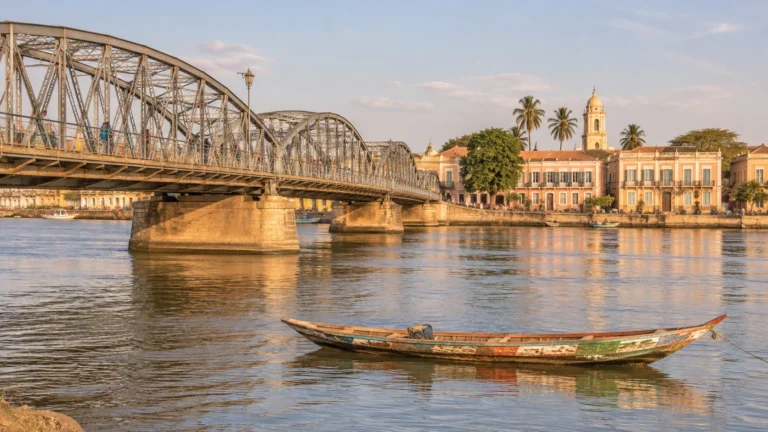
The Lompoul desert is a massif of ochre dunes in the Kébémer department, near Lompoul-sur-Mer, halfway between Dakar and Saint-Louis. It is not a desert in the climatic sense but a pocket of inland dunes between the ocean and the savannah, and it is this contrast that strikes you.
A 451 km² zircon concession, granted in 2007 for 25 years, covers the area north of Dakar down to south of Saint-Louis; it is operated by Eramet Grande Côte. According to the press, in March 2025 all operators had left the dunes except one ecolodge, and camps were moved further away. The camps still open therefore change from one season to the next: call before paying a deposit.
In practice: do not book on the strength of a photo or an old article. Ask the camp whether it is open on your dates, how far it is from the natural dunes, and whether the transfer from the village is included.
Dakar to Lompoul: road, duration and sand track
From Place de l'Indépendance in Dakar, Google Maps records 176 km and about 3 h 16 via the A1, or 157 km and about 3 h 49 via the R70. The two are equivalent on paper: the choice depends on your departure time and the traffic leaving Dakar. Leave before 8 a.m., and fill up before leaving the main road: our guide to fuel in Senegal gives the benchmarks.
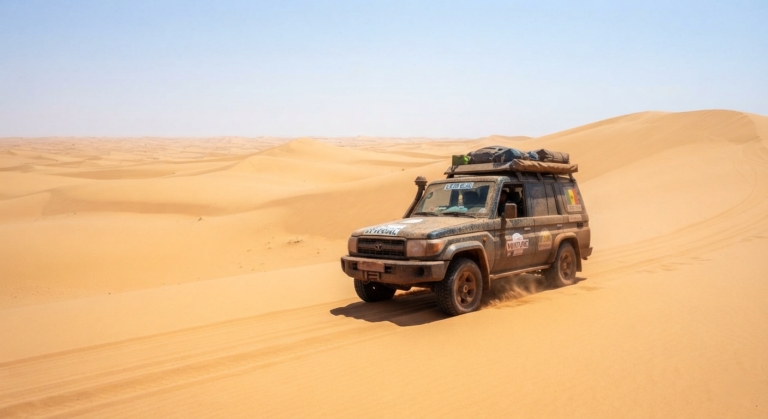
The paved road stops at the village of Lompoul. The last stretch is loose sand, passable only in a 4x4: most camps handle the transfer from the village, and some offer guarded parking. So park in the village and let the camp come and pick you up, rather than attempting the track with a saloon car. To choose the right vehicle, compare our article saloon, SUV or 4x4 and read our guide to Senegal's tracks: loose sand is unforgiving on worn tyres. The SUV and 4x4 in Dakar option suits this trip.
And what about Saint-Louis afterwards? A route with Lompoul and Ndiebene (Gandiol) as compulsory stops gives about 266 km and 5 h from Dakar to Saint-Louis, against 257 km and 4 h 43 by the direct road: the night in the desert therefore adds only about ten kilometres. Still, check the condition of the coastal road before committing to it, and see our article on driving from Dakar to Saint-Louis for the stops, then visiting Saint-Louis in two days.
How much does a night in a bivouac at Lompoul cost?
There is no official price list: each camp sets its own prices. As a benchmark, here are those of Eden Lodge, per person per night, tourist tax included, taken from its website on 28 November 2026.
| Tent type | Half board | Full board |
|---|---|---|
| Single | 39,000 FCFA | 45,000 FCFA |
| Double | 32,000 FCFA | 39,000 FCFA |
| Triple | 29,000 FCFA | 36,000 FCFA |
A couple in a double tent, on half board, therefore pays 64,000 FCFA a night, excluding activities and drinks. Children aged 3 to 12 get a 50% discount if they sleep in their parents' tent, and the driver or guide is housed and fed free of charge: an argument for a package with a driver. Payment is by cash, bank transfer, Orange Money or Wave; cancellation is free before the day of arrival, and a 20% deposit may be requested in high season. These conditions are those of one camp: ask for them in writing from the one you choose.
Organising your night, from arrival to sunrise
- Before leaving: book and confirmGet a written quote with the price per person, the board, the tourist tax and the transfer. Confirm the camp's status a few days beforehand.
- Leave Dakar before 8 a.m.You reach the village of Lompoul in the middle of the afternoon, with time for lunch on the way. Avoid the long religious weekends, when the roads north are saturated.
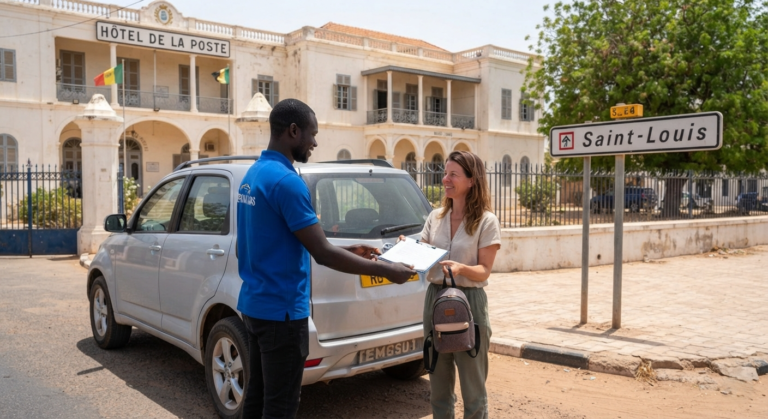
- The village, then the 4x4 transferLeave your car in the village and get into the camp's 4x4 for the last stretch of sand.
- Late afternoon in the dunesWalk up to the crest, sandboarding (free at Eden Lodge), a camel ride of about 20 minutes for 4,000 FCFA, a quad bike for 45 minutes at 30,000 FCFA. Save the sunset for the top of the dunes.
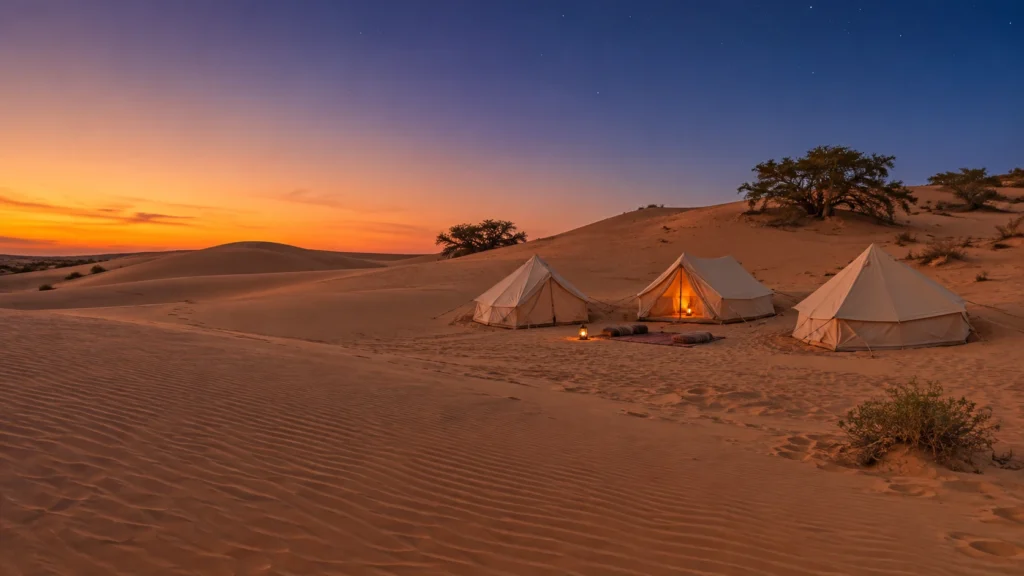
- Evening in the tent and under the starsDinner on site, a campfire, then a rare silence. Evenings get cool in the dry season: bring a warm layer.
- Sunrise, then back on the roadClimb the dunes at dawn, breakfast, transfer to the village, and back on the road to Saint-Louis or Dakar.
- ▸Closed shoes: thorny shrubs hurt bare feet.
- ▸No swimming at the nearby beach: the currents of the Grande Côte are dangerous.
- ▸No arriving at night: driving at night in Senegal carries real risks.
When to go, and for how long?
The dry season, from November to April, offers the most pleasant days and cool nights; from July to September, the rainy season, the sand is damp and the tracks less safe. One night is enough to see the sunset and the sunrise without inflating the budget. A day visit is possible from Dakar, but it means leaving very early and coming back at night, which we advise against.
Lompoul fits naturally into a broader itinerary: a detour via Lake Retba (the Pink Lake) before setting off, a night in the dunes, then Saint-Louis. Our 3 to 15 day road trip describes the sequence, and the page car rental in Saint-Louis lets you continue on site. To return the car at the end of the trip, see one-way rental.
Frequently asked questions
Yes, but zircon mining has damaged it and several camps have closed or moved. Some camps still welcome visitors: confirm they are open before paying a deposit.
About 3 h 16 for 176 km via the A1 from Place de l'Indépendance, or about 3 h 49 for 157 km via the R70, according to Google Maps. Add the last stretch of sand in a 4x4.
The paved road leads to the village. To reach the camps, the loose sand requires a 4x4: most camps handle the transfer from the village, where you can park your car.
At Eden Lodge, from 29,000 to 45,000 FCFA per person per night depending on the tent and the board, or 64,000 FCFA for a couple in a double tent on half board. Other camps have their own prices: ask for a quote.
Yes. One night lets you see the sunset and the sunrise over the dunes without inflating the budget. A second night is mostly justified if you want to do nothing at all.
The essentials before booking your night
Confirm that the camp is open, ask for a written quote including the transfer, leave Dakar before 8 a.m. and leave the car in the village: everything else comes with the dunes.
Head to the desert with the right vehicle
An SUV or a 4x4, with or without a driver, picked up in Dakar: you drive north without worrying about the sand on the last stretch.
Book my 4x4 in Dakar →