At the end of the northern road, where the Senegal River spreads into marshland before reaching Mauritania, hundreds of thousands of birds land each winter after crossing the Sahara. Here is how to organise a pirogue outing in Djoudj, which months to choose, what you really see there and how to get there by car from Saint-Louis or Dakar.
Djoudj at a glance: why this park matters
Created in 1971 and listed as a UNESCO World Heritage Site in 1981, the Djoudj National Bird Sanctuary covers about 16,000 hectares of lakes, marshes, oxbows and reedbeds on the left bank of the Senegal River. Its location explains its success: it is one of the first true wetlands that migrants from Europe meet after the desert, which makes it a major wintering site for Palearctic waterfowl.
Population figures vary by source and by year: estimates range from one to three million birds at the height of the season. Above all, remember that the density is spectacular, and that the visit is made on the water rather than on the track.
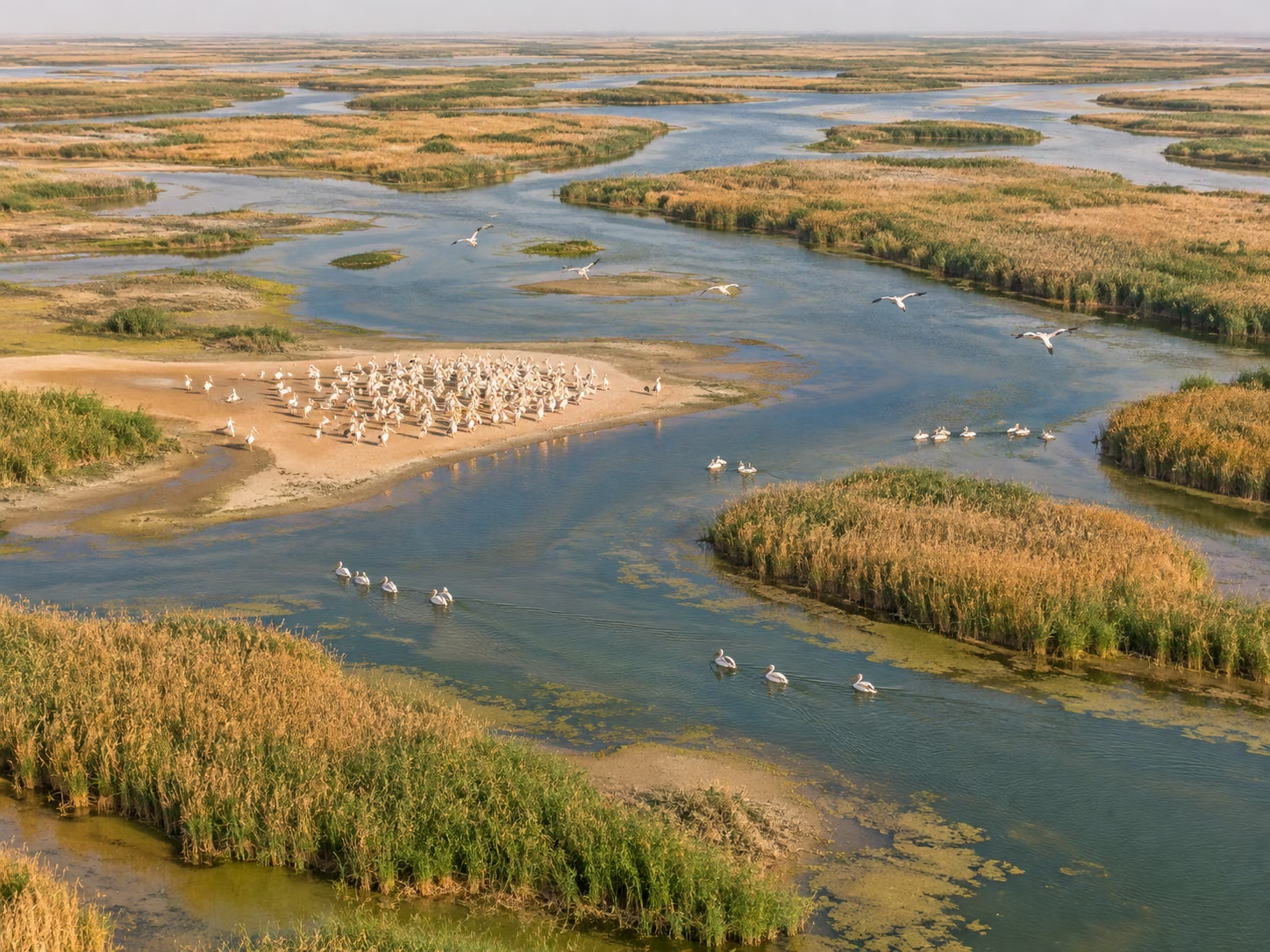
Best season: November to April, with a winter peak
Guides agree on a window from November to April: the migrants are present and the water level allows navigation. The birds peak from December to February. March and April still offer fine sightings, with fewer people and a heat that rises quickly in the middle of the day.
- ▸Several sources state that the park is closed from July to October, when the tracks are impassable or the water is too high.
- ▸The exact opening dates change from year to year: confirm them with an agency in Saint-Louis or with the park before driving all the way there.
| Period | Birds | Atmosphere and conditions |
|---|---|---|
| November | Migrants arriving, numbers rising | Pleasant temperatures, water still high, park recently reopened |
| December to February | Peak presence, very dense pelican colonies | Cool mornings, maximum crowds, book the day before |
| March to April | Fine sightings, gradual departures | Fewer people, strong heat from 11 a.m. |
| May to June | Few migrants | Very hot, visit not recommended unless unavoidable |
| July to October | Park closed according to some sources | Rainy season, waterlogged tracks |
The pirogue outing: the heart of the visit
You do not explore Djoudj at the wheel: the track leads to the landing stage, then everything happens on the waterways. The pirogues, often shared between several visitors, glide along the edge of the reeds for about an hour and a half. The boatman slows down near the islets where the pelicans nest so as not to make them take off.
What you actually see
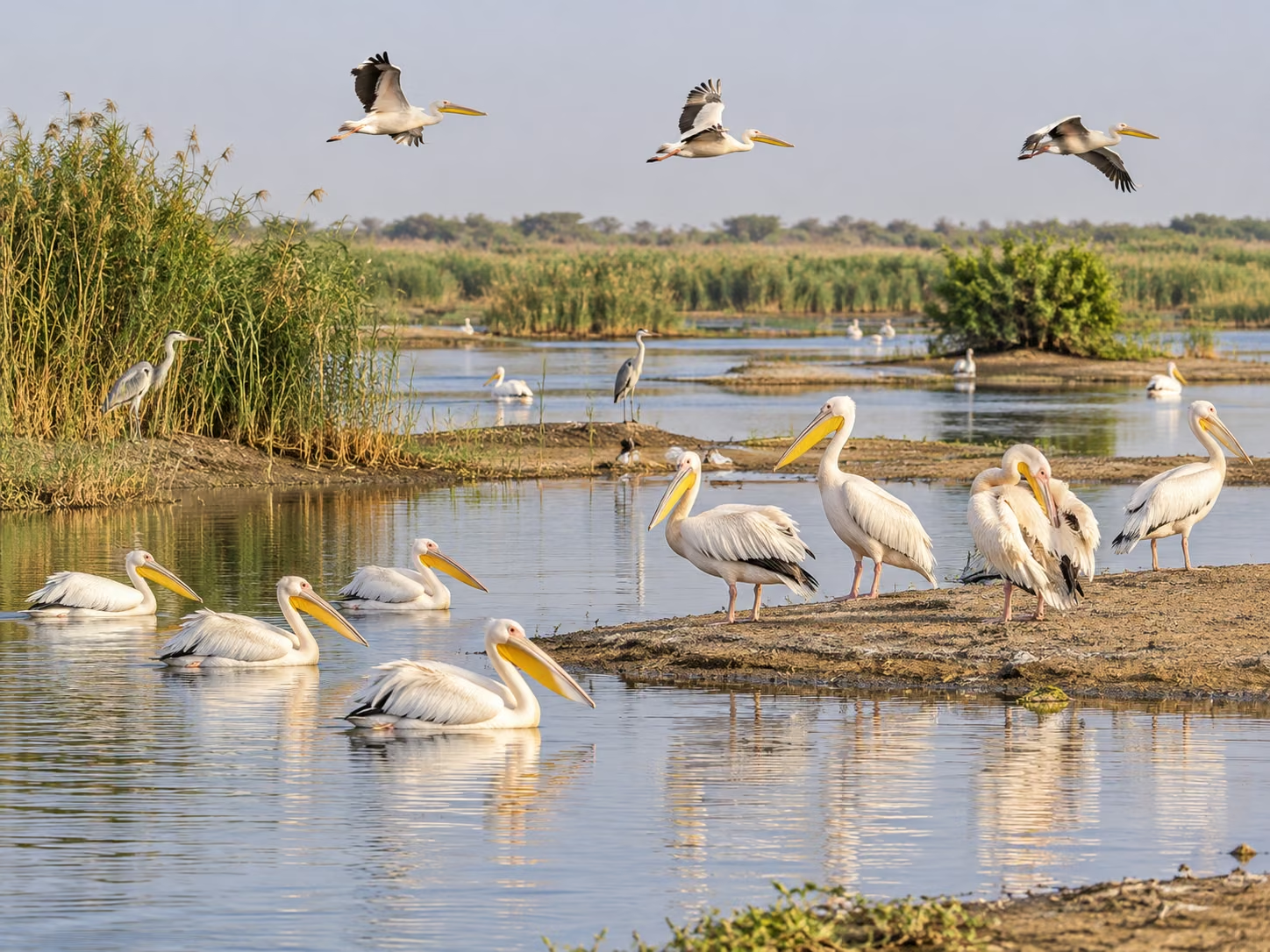
The great white pelican is the star, in colonies of several thousand birds on the islets. Around it: African cormorants drying their wings held out horizontally, African darters with their snake-like necks, great egrets, yellow-billed storks, grey herons and African fish eagles perched on dead trees. Flamingos tend to stay near the park entrance, in the shallow water, and you rarely see them from the pirogue.
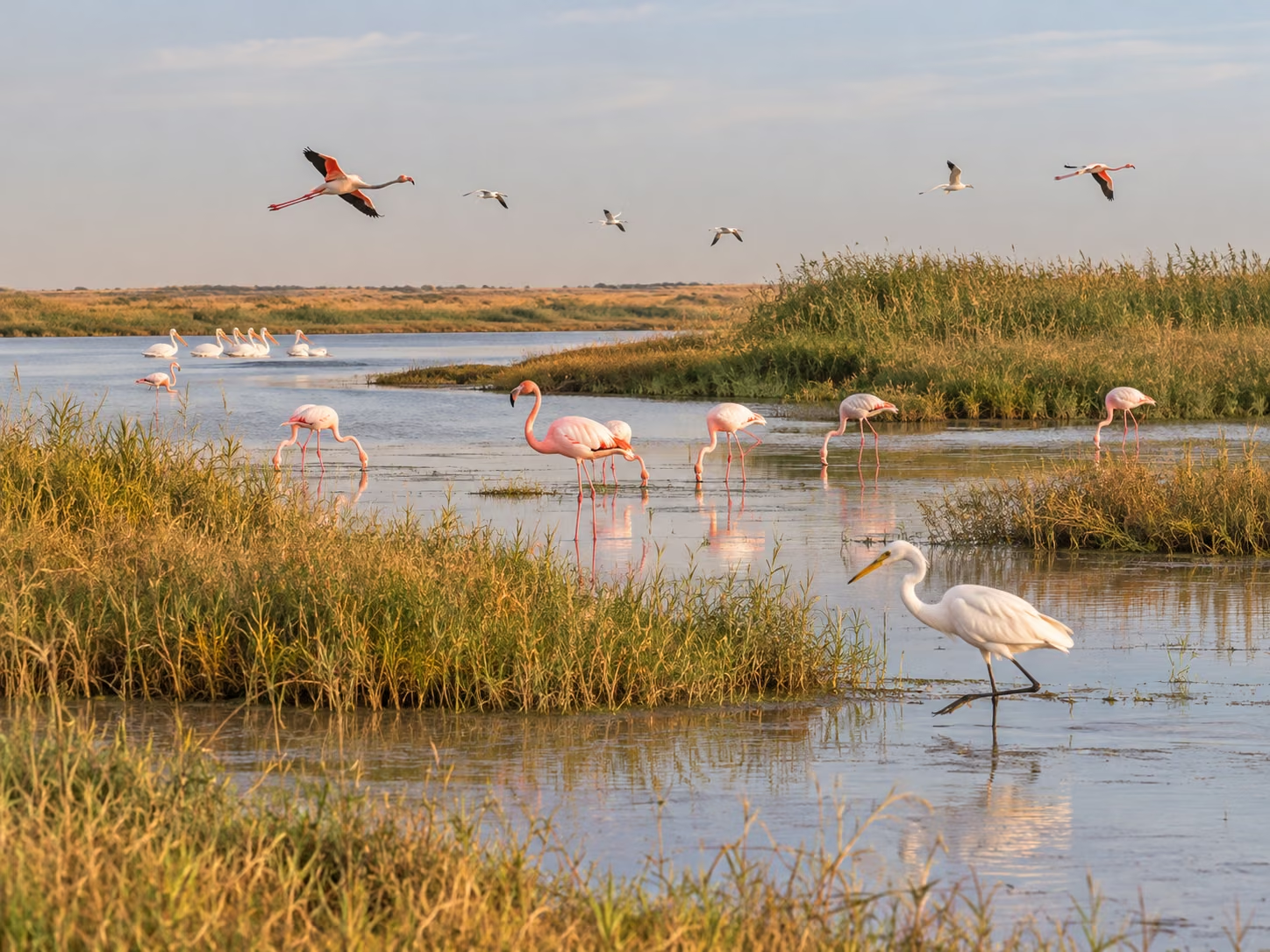
As for land wildlife, warthogs often come close to the landing stage, and with a bit of luck you may spot patas monkeys, monitor lizards or Nile crocodiles.
Budget: a rough figure to confirm
According to recent travel guides, expect about 5,000 FCFA for the entrance, 6,000 FCFA for the guide (described as compulsory) and 5,000 FCFA for a shared 1h30 pirogue. These prices change: they are given here as a guide only and should be checked before you leave, preferably through the agency booking your outing. A tip of about 500 FCFA for the boatman is customary.
Getting there: from Saint-Louis or from Dakar
The logical base is Saint-Louis, about 60 km away, or 1h30 by road depending on the state of the track on the last stretch. From Dakar, the distance to Saint-Louis is about 260 km: allow 3h30 to 4h30 depending on traffic leaving the capital. A same-day round trip is possible but exhausting; sleeping in Saint-Louis the night before lets you be at Djoudj as soon as it opens, when the birds are most active.
- The day before: reach Saint-LouisLeave Dakar early in the morning to avoid the traffic jams, then spend the night on the historic island or on the Langue de Barbarie.
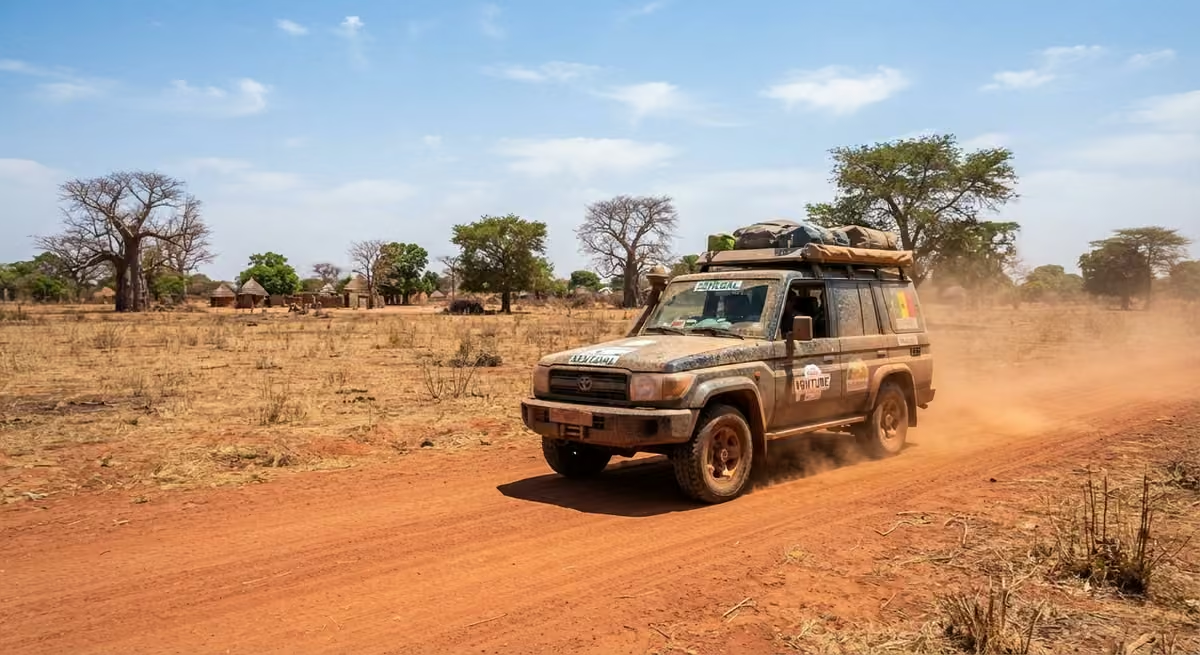
- At dawn: the road to DjoudjAbout 1h30 from Saint-Louis. The last stretch is on a track: drive slowly, animals cross it.
- Morning: boardingEntrance, guide, then pirogue. Binoculars, a hat and water are essential.
- Midday: a relaxed returnLunch in Saint-Louis or on the way, then a visit to the historic town in the afternoon.
As for the formula, it all depends on your pace. A SUV or 4x4 rental in Saint-Louis is reassuring on the tracks; a driver in Saint-Louis spares you from driving at dawn and on the way back; a local guide helps you identify the species. To compare all the options and the vehicles available on site, see our page on car rental in Saint-Louis, the natural starting point for Djoudj. For a one-way trip, our guide to one-way rental Dakar, Saint-Louis, Ziguinchor sets out the conditions.
The North is also best travelled with an eye on the map: the Mauritanian border crossing at Rosso or Diama is very close, and the state of the laterite roads is explained in our article on tracks and 4x4 in the rainy season.
Djoudj or another safari: which to choose for your trip?
Djoudj answers a precise wish: water, birds, silence. If you are looking for giraffes and rhinos to approach in a 4x4, look instead at the Fathala reserve or at the Bandia versus Fathala comparison. For another pirogue outing, further south, between mangrove and bolongs, the Sine-Saloum delta offers a very different setting. And if you are putting together a longer itinerary, our 3 to 15 day road trips include the North.
Visiting without disturbing
- ▸No drones: they frighten the colonies and can cause mass take-offs.
- ▸Stay seated and quiet in the pirogue when the boatman approaches an islet.
- ▸Do not feed any animal and take your waste with you.
- ▸Bring binoculars and a 200 mm lens or longer: the birds keep their distance.
Frequently asked questions
From November to April, with a peak of migratory birds from December to February. From July to October, the park is closed according to several sources, because of the tracks and the water level.
Allow about 1h30 in a shared pirogue. Plan on half a day in total, including the road from Saint-Louis, which is about 1h30 each way.
It is possible but very long: about 260 km to Saint-Louis, then another hour and a half. Sleeping in Saint-Louis the night before makes the visit more comfortable and puts you at Djoudj early in the morning.
Not always, but the last stretch is a track whose condition varies. A high-clearance car or a SUV is more reassuring, especially after the rainy season.
Mostly great white pelicans in large colonies, African cormorants, darters, egrets, yellow-billed storks and African fish eagles. Flamingos are mostly seen near the park entrance.
Conclusion
Djoudj is not a place to rush: a night in Saint-Louis, a departure before sunrise and a silent pirogue are enough to keep a sharp memory of it. Above all, choose your month carefully: between December and February, the spectacle is at its peak.
Prepare the northern road with peace of mind
Car with or without a driver, 4x4 for the tracks: choose the option that suits you before setting off for Saint-Louis.
Book my car in Saint-Louis →