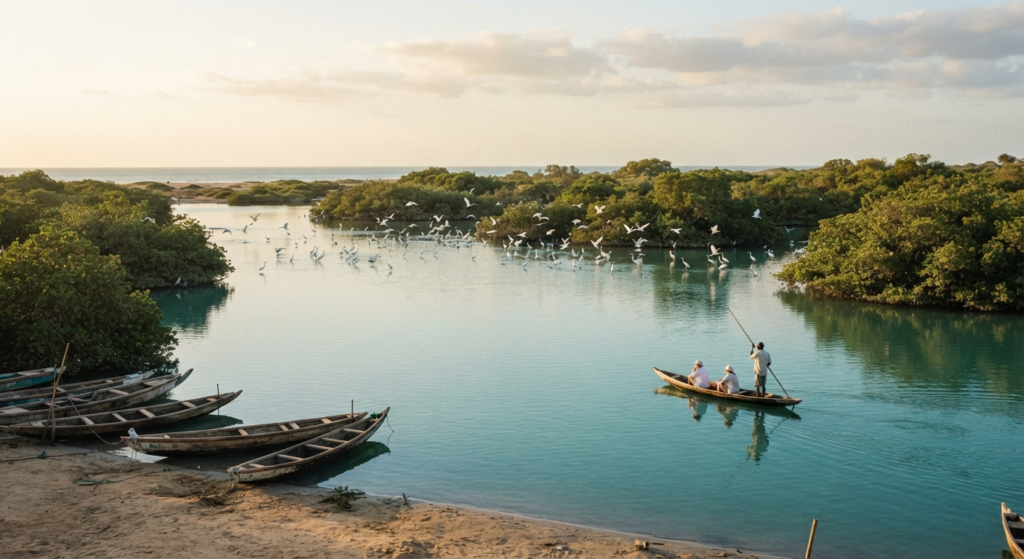
Past Fatick, the road leaves the dry landscapes of the Petite Côte behind and follows a maze of sea channels lined with mangrove. The Sine-Saloum delta isn't really a place you visit by car: you drive to the jetty, then board a pirogue to glide between the bolongs and fishing villages. Here's how to organise this excursion from Saly or Dakar, without losing a whole day on the road.
Why the delta is explored by pirogue, not by car
The Sine-Saloum is a maze of 52 islands and islets separated by bolongs, those sea channels lined with mangrove trees that have no bridges or driveable tracks. Once you reach Toubacouta, Ndangane or Djifère, the car stops at the jetty: the rest of the journey is done by motorised pirogue, piloted by a boatman who knows the channels at low tide like no one else. It's this break in rhythm, the road giving way to water, that gives the delta all its charm.
The UNESCO Biosphere Reserve classification protects 180,000 hectares of mangrove, tannes (salt flats) and open woodland. Here you'll find oysters clinging to mangrove roots, dozens of species of water birds and, sometimes, dolphins swimming up the channels in search of fish.
Reaching the delta by car: Toubacouta or Ndangane?
Two main gateways lead into the delta, each with its own atmosphere and its own excursions.
| Starting point | Distance from Dakar | Atmosphere |
|---|---|---|
| Toubacouta | About 230 km, allow 3h30 to 4h of driving | Villages, nature lodges, access to the Diorom Boumak shell mounds |
| Ndangane | About 160 km via Fatick, roughly 2h30 to 3h | Historic pirogue departure point, closer to Djifère |
The road is paved all the way to both jetties, but the final stretch often runs on laterite tracks; during the rainy season (July to October), a higher-clearance vehicle is best. For this route and the whole Petite Côte, a car with a local guide from Saly saves you from finding your way through the villages, and the guide often negotiates the boatman's rate on site too.
Bolongs and villages not to miss
- Ndangane or Toubacouta jettyDeparture early in the morning, between 7:30 and 8am, to enjoy the low light and avoid the midday heat on the water.
- Diombos bolongThe first channel crossed, lined with dense mangrove where herons and cormorants nest.
- Diogane villageA stop to watch the traditional harvest of mangrove oysters and chat with the fishermen.
- Falia, on foot from DioganeA roughly 2-hour walk through open woodland leads to this more remote village, rarely visited by organised tours.
- Diorom Boumak shell moundsA funerary shell mound dated from the 7th to 13th century, now a protected site, just a few minutes by pirogue from Toubacouta.
- DjifèreA fishing village at the river mouth, where pirogues loaded with fish return at the end of the day.
- ▸Over 100 bird species recorded: goliath herons, grey and white pelicans, ospreys, Caspian terns
- ▸Dolphins regularly seen in the widest channels, especially early in the morning
- ▸Shoals of mangrove oysters clinging to the mangrove roots, harvested by the women of the villages
Planning your excursion: duration, prices, best season
Allow half a day for a simple loop through the nearby bolongs, and a full day (often 6 to 10 hours by pirogue) to reach Djifère via the villages and return through the interior of the delta. Lunch, usually grilled fish, is generally prepared on board by the crew. The dry season, from November to June, offers calmer water and better visibility for birdwatching; during the rainy season, the bolongs rise and some passages become impassable at low tide.
- ▸Book the boatman the day before through your lodge or guide, spots fill up fast in high season (December to February)
- ▸Protect cameras and phones from sea spray, especially on the choppier stretches
- ▸Bring a hat and sunscreen: there's no natural shade for much of the trip
Extending the trip along the Petite Côte
The Sine-Saloum delta naturally complements a stay on the Petite Côte: many travellers continue on from the shell island of Joal-Fadiouth, just over an hour's drive away, or from the Somone lagoon for a nature-focused weekend without heading back through Saly. If you're starting from the fishing port of Mbour, the drive to Toubacouta takes just under two hours.
Frequently asked questions
Half a day is enough for a short loop through the bolongs near the jetty. To reach Djifère and see several villages, allow a full day, often 6 to 10 hours by pirogue with an on-board lunch break.
Toubacouta is closer to the Diorom Boumak shell mounds and remote nature lodges, while Ndangane is the historic departure point towards Djifère. Both are equally good, the choice mostly depends on where you're staying the night before.
Yes, but during the rainy season (July to October) the water level in the bolongs rises and some passages become impassable at low tide. The dry season, from November to June, remains the most comfortable time for birdwatching.
It's recommended, especially in high season (December to February) when lodges often book their regular boatmen the day before. A local guide can arrange it for you ahead of the trip.
Dolphins regularly swim up the widest channels of the delta, especially early in the morning, but spotting them depends on the tides and is never guaranteed on a single outing.
In short
The Sine-Saloum delta has to be earned: two to four hours' drive from Dakar, then a full day at the pace of the pirogue and the tides. It's exactly this contrast, between the Senegalese road and the silence of the bolongs, that makes the excursion memorable.
Plan your route to the Sine-Saloum
Book a suitable car to reach Toubacouta or Ndangane from Dakar or Saly, with or without a driver.
Book my car in Senegal →