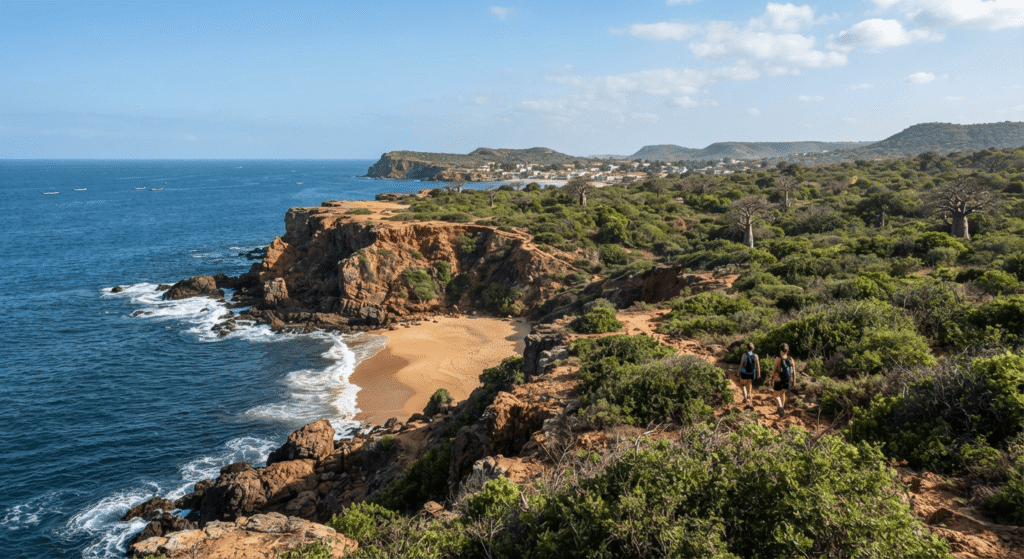
An hour's drive from Dakar, Popenguine Nature Reserve is the only spot on the Petite Côte where the Atlantic crashes against cliffs instead of sand dunes. Here's how to plan your day, between birdwatching and a fishing village.
A unique rocky coastline on the Senegalese shore
Created in 1986, Popenguine Nature Reserve covers about 1,000 hectares of cliffs, coastal savanna and plateaus swept by the trade winds. Everywhere else along the Petite Côte, the sea meets fine sandy beaches: here, it pounds against ochre rocky outcrops, an almost unexpected landscape at this latitude. It's this geological singularity, as much as the richness of its wildlife, that justified the site's protected status.
The village of Popenguine itself, a short walk from the reserve, keeps a distinct identity: it's a major site of Senegalese Marian pilgrimage, with a sanctuary that draws tens of thousands of pilgrims every year in late August. Outside that period, the town stays peaceful, almost sleepy, with its shaded lanes and fishermen's houses.
- ▸Area: about 1,000 hectares of cliffs, coastal savanna and plateaus
- ▸Distance: about 70 km south of Dakar, around twenty minutes from Saly
- ▸Hours: open daily, generally 8am to 6pm
- ▸Entrance: from 1,000 FCFA per person, local guide around 5,000 FCFA
What to see and do in the reserve
The reserve is home to dense birdlife, a real playground even for casual birdwatchers: hornbills, turtle doves, coastal raptors and many migratory species depending on the season. On the ground, you might spot warthogs, jackals or porcupines, rather discreet and mostly active in the early morning. From June to November, nesting season also brings sea turtles to certain stretches of the protected coastline.
There are two ways to explore the site: on foot, along the marked trails that run along the cliffs (allow 2 to 3 hours for a comfortable loop), or by mountain bike to cover more ground. Some local operators also offer a small train that stops at the most photogenic viewpoints, a practical option with children or in hot weather.
The best time to come
The dry season, from November to May, offers the most comfortable temperatures for walking on the exposed plateaus: clear skies, cool trade winds, maximum visibility for birdwatching. The low, slanting light of late afternoon on the ochre cliffs remains the most spectacular moment for photographers. During the rainy season (July to September), the vegetation turns spectacularly green but some trails become slippery, making a local guide particularly useful.
Walkers and photographers
Favor early morning or late afternoon, when the light sculpts the cliffs and the birds are most active.
Families
The small train or a short loop let you discover the site without exhausting the little ones, provided you come early to avoid the heat.
Birdwatchers
Binoculars are a must: the best sightings happen near the cliffs and the low savanna areas, early in the morning.
Getting there from Dakar or from Saly
Popenguine is easy to reach by car, whether you're leaving from the capital or already staying on the Petite Côte. From Dakar, allow about 1h15 via the toll motorway then the main road, a trip many travelers prefer to leave to a driver who knows the routes and the times to avoid at the city entrances. From Saly, the reserve is only about twenty minutes away, making it an easy half-day excursion to combine with the Somone bird reserve, nearby, for bird lovers who want to compare the two ecosystems on the same day.
Those already staying in Saly often choose a car with driver from Saly, handy for combining Popenguine with other stops on the Petite Côte without worrying about parking or the secondary tracks that are sometimes poorly signposted near the village.
Popenguine's Marian pilgrimage, in late August, transforms the village for a weekend: heavy traffic, fully booked accommodation. If your visit isn't about this event, it's better to aim for another period to enjoy the reserve's calm.
Frequently asked questions
A half-day is enough for a 2 to 3 hour walking loop with birdwatching. Allow a full day if you combine the reserve with the village and the sanctuary.
No, but strongly recommended: local guides, around 5,000 FCFA, know the birdwatching spots and the areas to avoid after heavy rain.
The coastline is mostly rocky and the swell can be strong: swimming isn't the point of the site. The nearest sandy beaches are around Saly or Somone.
The dry season, from November to May, offers the best visibility. Sea turtles, meanwhile, are more likely to be seen from June to November on certain stretches of coastline.
The simplest solution is a car with driver from Dakar or Saly, which avoids local transport connections and adapts to tide and light schedules.
In summary
Popenguine stands apart from the rest of the Petite Côte through its relief and its atmosphere: a place to come and walk, observe, breathe, rather than sunbathe. A well-planned half-day, with or without a guide, is enough to understand why regulars in the region often save it for the end of their stay, as a counterpoint to the beaches of Saly.
Want to explore the Petite Côte at your own pace?
Book a car with driver and let yourself be taken to Popenguine, with no route stress or parking worries.
Book my car →