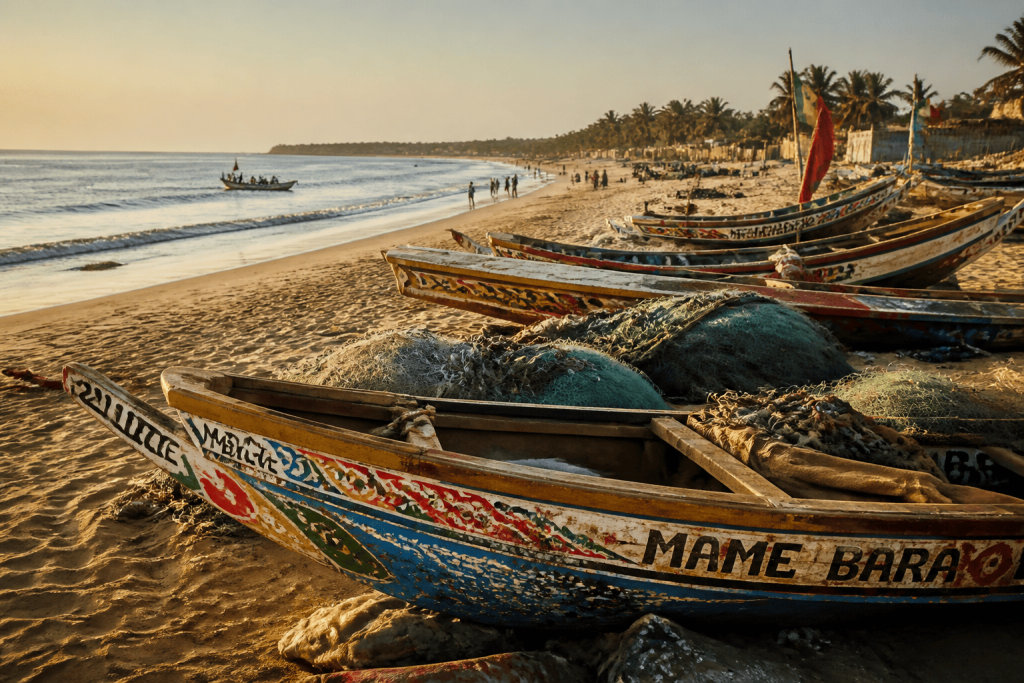
Every late afternoon, Mbour beach turns into an open-air theater: dozens of pirogues come back loaded with the day's catch. Here's how to experience this moment without ever feeling like you're intruding.
Senegal's second fishing port
About 80 km south of Dakar, Mbour is the country's second largest artisanal fishing port, right behind the capital. Unlike Saly, its beach-resort neighbor just a few minutes away by road, Mbour is nothing like a tourist town: it's a working town, where fishing supports thousands of families and literally sets the rhythm of the days, between the pirogues leaving at dawn and their return in the late afternoon.
This proximity to Saly makes it an ideal excursion to slip into a stay on the Petite Côte: an hour or two is enough to soak up the atmosphere, without needing to spend the whole day there.
The fishermen's return, a spectacle to respect
Around 5pm, the scene begins: brightly colored pirogues, sometimes a dozen at once, cross the wave break to run aground on the sand. The men unload the crates, the women take over to sort, scale and negotiate on the spot, while children weave between the baskets. It's a moment of work before it's a spectacle: keep that in mind, stay back from the maneuvering areas and always ask before photographing someone up close.
The fish market, just behind the beach, extends the visit: colorful stalls, an informal auction, briny smells. You'll find everything there, from thiof (a prized local grouper) to small dried fish destined for regional export.
The low light at the end of the day is stunning on the pirogues on the sand: it's also the busiest and most photogenic time slot, but also the most crowded. Arriving just before 5pm lets you find a good spot without getting in the way of the unloading.
Visiting with or without a guide?
Licensed local guides offer tours of the port and the craft market, generally around 5,000 FCFA for a group. Their value goes beyond simple translation: they know where to stand without getting in the fishermen's way, explain traditional fishing techniques and make it easier to talk with the women selling fish, who are often happy to chat if approached respectfully.
Without a guide, the visit remains possible and free, but calls for more tact: observe first, keep a reasonable distance from the unloading areas and avoid haggling over the photo the way you would haggle over the fish.
- Arrive in the late afternoonAim for 4:30-5pm to see the unloading without the crowd of peak activity.
- Watch from the beachStay back from the pirogues' maneuvering areas, the sand can be slippery and the pace of work fast.
- Walk through the fish marketJust behind the beach, to see the sorting, the auction and the preparation of the catch.
- Extend into town if time allowsMbour's town center keeps an authentic, popular character, far from Saly's beach-resort atmosphere.
Getting there from Dakar or Saly
From Dakar, allow about 1h30 of driving, a trip many prefer to hand over to a driver who handles the exit from the city and the usual slow-traffic zones rather than drive themselves at the end of the day, when traffic gets heavy again. From Saly, on the other hand, Mbour is only 10-15 minutes away: an easy excursion to combine with a beach afternoon, for example by heading back to the Saly coast once the market has been visited.
For those already staying on the Petite Côte, a self-drive car rented in Saly is more than enough for this short trip, which can be repeated over several days if you want to come back and watch the port at different times.
Frequently asked questions
Generally around 5pm, but the time varies depending on the tide and the season. Allow a margin of 30 to 45 minutes before or after the stated time.
No, but a local guide greatly improves the experience: they know the good spots and enable more natural exchanges with the fishermen and the women selling fish.
Always ask permission before photographing someone up close. Wide shots from the beach generally raise fewer questions.
One to two hours are enough for the port, the unloading and the fish market. Allow more if you extend into the town center.
Yes: at 10-15 minutes by road, it's one of the most accessible excursions on the Petite Côte, and one of the few that shows a Senegal far from the beach-resort atmosphere.
In summary
Mbour is nothing like a frozen postcard: it's a lively, noisy, generous port that shows, in the space of an hour, the most authentic side of the Petite Côte. A short stop, best timed just before sunset, to round off a beach stay with a dive into a working Senegal.
Want to discover the Petite Côte at your own pace?
Book a car with driver and string together Mbour, Saly and their surroundings without schedule constraints.
Book my car →