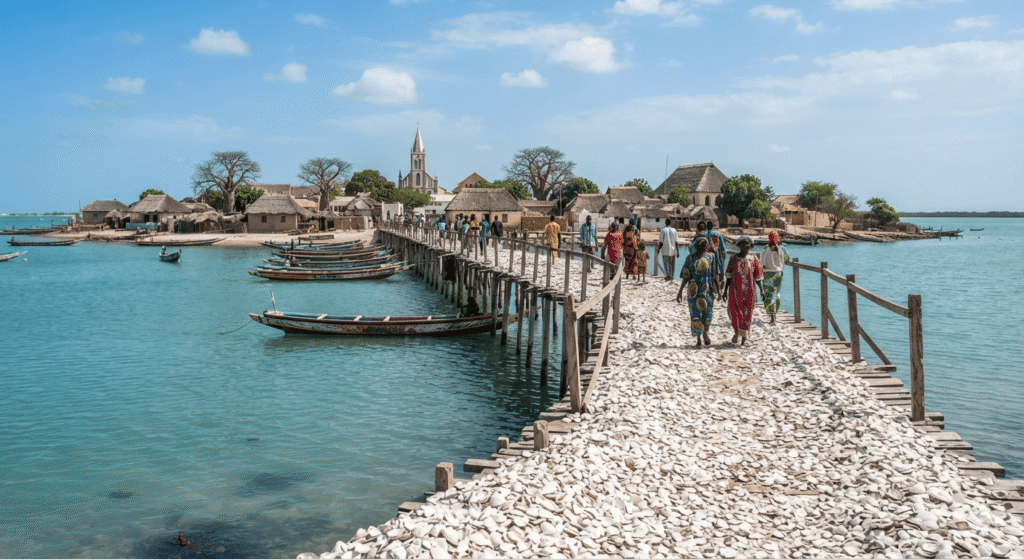
A fishing village on the mainland, an island built up over centuries of accumulated shells, and a 500-metre wooden bridge linking the two: Joal-Fadiouth ranks among Senegal's most singular sights. Here's how to organise a visit without missing anything essential.
Joal-Fadiouth in a nutshell
The name actually covers two quite distinct settlements. Joal, on the mainland, is one of Senegal's largest artisanal fishing ports, animated by the daily coming and going of pirogues. Fadiouth, its island extension, is an island built entirely on mounds of shells accumulated over centuries of eating oysters and cockles. The two are joined by a wooden footbridge some 500 metres long, crossed on foot in around ten minutes, or by pirogue for visitors who prefer the water.
Fadiouth, the shell island
From the first steps on the footbridge, the scenery changes: the island's alleyways are entirely covered in white shells, which crunch underfoot and cast an almost unreal light late in the day. The main street, locally nicknamed the "Champs-Élysées" with a knowing wink, is where craft shops and small businesses cluster.
Crossing the bridge, notice the old raised millet granaries on the right, once used to protect harvests from house fires. No longer in use today, they're preserved as a record of traditional Serer architecture.
Another rare feature in Senegal, an overwhelmingly Muslim country: Fadiouth has a mostly Christian population, and pigs are regularly seen in the alleyways, a detail that often surprises visitors coming from other parts of the country.
The shared cemetery, a symbol of coexistence
On a small separate islet, linked by an additional bridge, Fadiouth's cemetery holds Muslim and Christian graves side by side, crosses and crescents mingled on ground still covered in shells. This rare, peaceful coexistence has become the village's symbol and one of the most photographed sites on the Petite Côte. Please observe the same discretion here as in any place of remembrance: visit in silence, without walking on the graves.
Joal, the port and Senghor's house
Back on the mainland at Joal, for a visit of a very different kind. The village was the birthplace of Léopold Sédar Senghor, Senegal's first president and a major figure in Francophone literature. His childhood home, the Maison du Lion (Mbin Diogoye), has been turned into a small museum: explanatory panels and objects trace his life, with a guided tour of around 45 minutes offered on site.
Right next door, the fishing port is worth a detour late in the morning, when the pirogues return: an improvised fish auction, fish spread out on the ground, the smell of smoking, one of the liveliest scenes on the whole Petite Côte.
Planning your visit: access, prices, tips
Visiting the island generally goes through Joal-Fadiouth's local tourist office, which organises guided tours: expect around 5,000 FCFA for a guide on the island and cemetery, with a supplement of around 6,000 FCFA if you add a pirogue ride through the surrounding mangrove. Access to the footbridge and the village remains free if you'd rather wander on your own, but a local guide adds real value for understanding the history of the cemetery and the millet granaries.
- ▸Favour the morning or late afternoon: softer light, more bearable heat, and a better atmosphere at Joal's port when the boats return.
- ▸Closed shoes recommended: the shells can be sharp or slippery in places.
- ▸Bring cash in FCFA: few businesses on the island accept cards.
- ▸Avoid the rainiest period, from July to October, when paths can become muddy.
From Saly, the road is straightforward but long enough that chauffeur-driven car rental is well worth it: you enjoy the drive without worrying about parking in Joal, and the driver can wait during the guided tour. If Joal-Fadiouth is part of a wider Petite Côte circuit, our regional guide by car offers an itinerary combining all three destinations, and our complete guide to Saly remains useful for organising the rest of your stay. Along the way, a stop at Somone lets you combine the lagoon and the shell island in the same day.
Frequently asked questions
Two to three hours are enough for the footbridge, the island, the cemetery and a stop at Joal's port. Add the visit to the Maison du Lion if Senghor's history interests you.
No, the footbridge and alleyways remain freely accessible. A guide from the local tourist office does, however, add context on the cemetery and the millet granaries, for a modest fee.
Yes, several small places serve grilled fish and local cooking, both in Joal and Fadiouth. Nothing fancy, but the freshness of the day's catch more than makes up for it.
In summary
Between Joal's lively port, Senghor's childhood home and Fadiouth's white alleyways, this double visit offers one of the most striking cultural contrasts on the Petite Côte, less than an hour's drive from Saly or Somone.
Reach Joal-Fadiouth from Saly
Choose a chauffeur-driven rental to fully enjoy the drive and the guided tour without worrying about driving or parking.
See chauffeur-driven options in Saly →